At a glance
- The EU PEACE programmes began in 1995, and the current PEACEPLUS programme is worth 1.1 billion euros for 2021 to 2027.
- Re-Imaging Communities, launched in 2006 with 3.3 million pounds over three years, paid community groups to replace sectarian and paramilitary imagery.
- A 2013 government strategy pledged to remove all interface barriers by 2023, and many of the largest walls in Belfast are still standing.
In this article
- The agreement and the money behind it
- The main programs at a glance
- Murals: from gunmen to local history
- What happened to the new walls
- Theatre that puts testimony on stage
- A city of culture in Derry-Londonderry
- The walls that stayed up
- A timeline of key events
- What the arts could not change
- Lessons for arts-based peacebuilding elsewhere
- Key terms, discussion questions and FAQ
Northern Ireland is one of the most closely watched cases of arts and peacebuilding anywhere. Since the Belfast/Good Friday Agreement was signed on 10 April 1998, public bodies, the European Union and local groups have spent large sums on murals, theatre, festivals and shared cultural spaces, on the theory that what people see and make together can change how they live together.
Some of that work changed streets in visible ways. Gunmen on gable walls were painted over, a former army base in Derry-Londonderry became a public square, and theatre companies put testimony from the Troubles on stage. Other things barely moved. Most social housing is still divided by community, most children still go to schools that are largely Catholic or largely Protestant, and the tallest walls between neighborhoods are still up.
This article looks at the main programs, what their evaluations found and where the evidence is thin, and ends with lessons for a foundation, city or community group working in another divided place.
The agreement and the money behind it
The 1998 agreement was approved by referendum on 22 May 1998 and came into force on 2 December 1999, according to the UK government’s record of the text. It settled institutions and constitutional questions, not how neighbors on either side of a street would treat each other.
Much of the funding for that slower work came from Europe. The EU’s PEACE programmes started in 1995, three years before the agreement, and covered Northern Ireland and the border counties of Ireland. The Special EU Programmes Body (SEUPB), which manages them, gives these totals: 667 million euros for PEACE I (1995 to 1999), 160 million euros for a PEACE II extension (2004 to 2006), 333 million euros for PEACE III (2007 to 2013) and 269 million euros for PEACE IV (2014 to 2020).
PEACE IV split its money into four themes. Its SEUPB overview allocates 35.3 million euros to shared education, about 54.7 million euros to children and young people, about 99.3 million euros to shared spaces and services, and 64 million euros to building positive relations. The successor, PEACEPLUS, is worth 1.1 billion euros for 2021 to 2027, combining a 235 million euro EU contribution with UK, Irish and Northern Ireland funding (European Commission).
The main programs at a glance
Budgets below are those stated by the funder or a public body.
| Program | Years | Funder or lead | Budget or scale |
|---|---|---|---|
| PEACE I | 1995 to 1999 | EU with national co-funding | 667 million euros |
| PEACE III | 2007 to 2013 | EU with national co-funding | 333 million euros |
| PEACE IV | 2014 to 2020 | EU with national co-funding | 269 million euros |
| PEACEPLUS | 2021 to 2027 | EU, UK, Ireland, Northern Ireland | 1.1 billion euros |
| Re-Imaging Communities (first phase) | 2006 to 2009 | Arts Council of Northern Ireland with a consortium of public bodies | 3.3 million pounds over three years |
| Re-Imaging Communities (later phase) | 2013 to 2014 | PEACE III, Arts Council, International Fund for Ireland | 3.1 million pounds |
| Playhouse Theatre and Peacebuilding Academy | To 2020 | PEACE IV | Four residencies, 76 planned participants |
| UK City of Culture, Derry-Londonderry | 2013 | UK government title, local and national funding | Year-long program |
Murals: from gunmen to local history
Murals have been part of Northern Ireland’s streets since the early twentieth century and became known worldwide during the Troubles, as Andrew Hill and Andrew White note in Irish Political Studies. Many of the most familiar ones in loyalist and republican areas showed armed men, memorials to the dead or claims over territory.
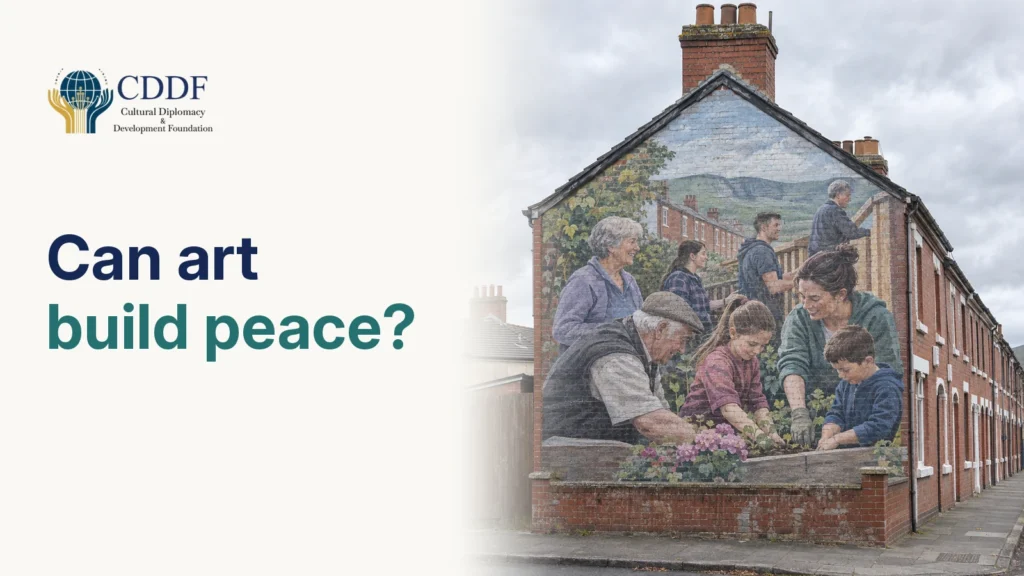
In 2006 a group of public bodies led by the Arts Council of Northern Ireland launched Re-Imaging Communities. According to the International Fund for Ireland’s announcement, the program had 3.3 million pounds over three years and was backed by the Department for Social Development, the Office of the First Minister and deputy First Minister, the Community Relations Council, the Housing Executive, the International Fund for Ireland and the Arts Council. Community groups could apply for up to 5,000 pounds for small projects and up to 50,000 pounds for larger ones, as long as the idea fitted their council’s Good Relations Strategy.
The design mattered. Groups chose what would replace an image, and community development workers were available to help groups that found the application process hard. The Extramural Activity mural archive, citing the program’s 2009 evaluation, reports that 39 mural projects were complete by summer 2009. In the lower Shankill in Belfast, six murals were replaced and four new ones added, with subjects such as local boxing history.
A second phase began in February 2013 with 3.1 million pounds from PEACE III, the Arts Council and the International Fund for Ireland. The Arts Council’s submission to an Assembly inquiry says the aim in towns was to clear public space of “visible displays of sectarian aggression and intimidation”, while rural projects looked at barriers to people moving freely. The same submission reports that the evaluation of the earlier phase found shared spaces, stronger community relations and a sense of local ownership, with some projects acting as a catalyst for further improvements.
What happened to the new walls
The record after the paint dried is mixed. Hill and White assess the program’s aims and achievements and raise questions about who governs the visual environment. Critics cited in the Extramural Activity history argued that some replacements were bland, that they did not reflect local history, and that state bodies, often from outside the area, were deciding what a neighborhood could show.
Some walls changed more than once. The same archive records a mural in Kilcooley, Bangor, where a gunman was replaced by a Victoria Cross memorial in 2009 and the wall was painted again in 2018, and notes that many re-imaged pieces were later replaced by new paramilitary images. A mural can be overpainted in an afternoon, so its survival depends on whether the people who live beside it want to keep it.
Our reading is that the program worked best where a group had a reason of its own to change the wall, such as a local sports story or a figure residents were proud of, and worst where the change was mainly a condition of funding.
Theatre that puts testimony on stage
Theatre has worked differently. Instead of changing what is on a street, it brings a small number of people into a room to hear each other. The Playhouse Theatre and Peacebuilding Academy in Derry-Londonderry, funded by PEACE IV, built on the Theatre of Witness model, in which people with direct experience of the Troubles tell their own stories on stage.
Its evaluation, by David Grant and Victoria Durrer of Queen’s University Belfast (November 2020), describes four artist residencies with a major production each, plus smaller local projects. The plan was for 76 cross-community participants. Participants and audiences described strong personal effects, and 209 audience members returned questionnaires across three productions.
The evaluators are candid about limits. The questionnaires came from self-selecting audiences and are not representative. They also recorded concerns that Protestant, unionist and loyalist voices were under-represented in one production, and one partner reported that some relationships were damaged. COVID-19 pushed the final production online in 2020. We think this kind of honest reporting is more useful to other funders than a list of positive quotes.
A city of culture in Derry-Londonderry
On 15 July 2010 the UK government named Derry-Londonderry the first UK City of Culture, for 2013, ahead of Birmingham, Norwich and Sheffield. The announcement credited the bid with “strong evidence of engagement across all parties and communities in the city.”
The year’s largest event was the Fleadh Cheoil, the traditional Irish music festival, which came to Northern Ireland for the first time. The Irish Times reported an estimated 430,000 people over the week, with a closing ceremony at Ebrington Square, a former army base turned public space.
Later evaluation was more sober. A post-project evaluation presented to Derry City and Strabane District Council, as reported by the Derry Journal, found that 300 to 400 new jobs were created in 2013, against a forecast of 2,800. The share of people from the most deprived areas who attended events and rated them excellent or very good rose from 10 percent in 2009 to 43 percent in 2013, and hotel room sales rose from 123,964 in 2012 to 172,259 in 2017. A Queen’s University Belfast research project on the year gave particular attention to the city’s Protestant community, citing evidence of “entrenched levels of cultural alienation.”
The walls that stayed up
Peace walls, or interface barriers, are the physical side of the same story. In May 2013 the Northern Ireland Executive published Together: Building a United Community, with four priorities: children and young people, a shared community, a safe community and cultural expression. The strategy pledged to “reduce, and remove by 2023, all interface barriers” (Evening Standard via Yahoo News).
Counting the barriers is harder than it sounds, because they belong to several owners. The main figures are:
- The Belfast Interface Project counted 116 walls, fences, gates and buffers across Northern Ireland in 2017, and 21 of them were outside the government’s removal target (The Detail).
- The Department of Justice took over 59 structures in 2010, and 46 remained in 2019 (Department of Justice framework document).
- In October 2021 a junior minister told the Assembly that Department of Justice structures were down to 43 (Evening Standard via Yahoo News).
- In August 2025 the Irish Times described the Cupar Way wall in west Belfast, 14 meters high and 650 meters long, as the highest and longest of those remaining.
Residents beside that wall told the paper they feel safer with it up. That view deserves weight. Murals were often re-imaged where residents agreed. Walls are removed only where people on both sides consent, and many do not yet.
A timeline of key events
| Date | Event |
|---|---|
| 1995 | PEACE I begins, the first EU peace program for Northern Ireland and the border counties |
| 10 April 1998 | Belfast/Good Friday Agreement signed |
| 22 May 1998 | Agreement approved by referendum |
| 2 December 1999 | Agreement comes into force |
| 2006 | Re-Imaging Communities launched with 3.3 million pounds over three years |
| 2007 | PEACE III begins (333 million euros) |
| 15 July 2010 | Derry-Londonderry named UK City of Culture 2013 |
| February 2013 | Second phase of Re-Imaging Communities launched (3.1 million pounds) |
| 23 May 2013 | Together: Building a United Community published, with the 2023 target for interface barriers |
| August 2013 | Fleadh Cheoil held in Derry-Londonderry, the first time in Northern Ireland |
| 2014 | PEACE IV begins (269 million euros) |
| July 2022 | European Commission announces PEACEPLUS (1.1 billion euros, 2021 to 2027) |
| 2023 | Target date for removing interface barriers passes with many still standing |
What the arts could not change
The arts in Northern Ireland have mostly worked on symbols and on relationships between small groups. The larger structures of division are housing, schooling and safety, and on these the numbers have moved slowly.
Housing is the clearest case. Research for the Northern Ireland Housing Executive, based on 2011 Census data, found that more than 90 percent of social housing areas were segregated, rising to 94 percent in Belfast, where segregated means at least 80 percent of residents come from one background (FactCheckNI). Schools are similar: about 8.5 percent of pupils attended an integrated school in 2024/25, according to an Ark policy brief from March 2025.
Three further limits recur in the evidence. A mural can be repainted overnight, so a change made with funding can be reversed without it. Evaluations often rely on self-reported feelings from people who chose to take part, which says little about the wider population. And cultural programs can deepen a sense of exclusion if one community feels the program was not built for it, as the Queen’s research on Derry-Londonderry suggests.
Lessons for arts-based peacebuilding elsewhere
Northern Ireland had outside funding on a scale few places will see. Still, several lessons travel, as they did after the rebuilding work in Mostar and Mosul. They connect to the argument in our piece on culture as development, and to the role of women and young people discussed in who gets a seat at the table.
Let residents decide what replaces a contested image
The strongest Re-Imaging projects were chosen by the people who walk past the wall each day. A funder can set limits, such as no weapons or threats, and leave the subject to local groups. In our reading of the archive, murals chosen locally were less likely to be painted over.
Fund for decades, not single grants
The PEACE programs have run since 1995 under five successive budgets. That continuity let groups build skills and trust across several funding rounds. Short grants tend to produce one-off events.
Use single-identity and cross-community work in sequence
The Playhouse academy mixed groups drawn from one community with groups from both. Single-identity work can give a group the confidence to meet the other side later, but it should lead somewhere. PEACEPLUS now funds co-designed local action plans in 17 council areas, one of whose themes is respect for all cultural identities, with a 110 million euro call (SEUPB) and a separate 35 million euro call for building positive relations (SEUPB).
Plan the evaluation before the work starts
A practical sequence for a funder or city might look like this:
- Agree with residents which contested images or spaces matter most, and record a baseline of attitudes and use of space before any work begins.
- Set a funding horizon of at least five to seven years, with smaller grants open to groups new to public funding and support staff to help them apply.
- Pair each single-identity project with a planned point of contact with the other community.
- Measure outcomes beyond the participants, such as who uses a space after a project ends and whether a new mural survives.
- Publish negative findings, as the Playhouse evaluation did, so that other places can learn from them.
Key terms
Interface barrier: A wall, fence or gate built to separate neighboring Catholic and Protestant areas, often called a peace wall.
Re-imaging: Replacing a sectarian or paramilitary mural or emblem with a new image chosen with local residents.
Single-identity work: Community work with people from one background, often used to build confidence before cross-community contact.
PEACE programmes: EU-funded programs for Northern Ireland and the border counties of Ireland, running since 1995 and managed by the Special EU Programmes Body.
Theatre of Witness: A form of theatre in which people tell their own stories of conflict on stage, rather than actors playing them.
Questions for discussion
- Who should decide what replaces a contested mural, and what limits should a funder set?
- How can a festival or cultural year reach a community that feels the program was not designed for it?
- What would count as good evidence that an arts project changed relations beyond its own participants?
- When is single-identity work a step toward contact, and when does it reinforce separation?
Frequently asked questions
What role have the arts played in Northern Ireland’s peace process?
They have changed visible symbols such as murals and given small groups from both communities a place to meet. They have done much less about housing and school segregation.
What was Re-Imaging Communities?
A program launched in 2006, led by the Arts Council of Northern Ireland, that funded community groups to replace sectarian and paramilitary imagery. Its first phase had 3.3 million pounds over three years.
How much has the EU spent on peace in Northern Ireland?
The SEUPB lists 667 million euros for PEACE I, 333 million for PEACE III and 269 million for PEACE IV, and PEACEPLUS is worth 1.1 billion euros for 2021 to 2027.
Were the peace walls removed by 2023?
No. The 2023 target from Together: Building a United Community was not met, and large walls such as Cupar Way in west Belfast still stand.
Did the 2013 City of Culture improve community relations in Derry-Londonderry?
It drew large crowds and raised participation in deprived areas, but job creation fell far short of forecasts and research found continuing cultural alienation among some Protestant residents.
Can these lessons apply outside Northern Ireland?
Local ownership, long funding and honest evaluation travel well, though few places will match the scale of PEACE funding.
Closing thoughts on arts and peacebuilding
Northern Ireland shows what arts and peacebuilding can do when the money lasts for decades: change the images people pass every day, give victims a stage, and bring large crowds to a shared celebration. It also shows the limits. The walls in west Belfast, the divided estates and the separate schools were not changed by murals or plays, and no evaluation claims they were.
For a foundation or city considering similar work, the most useful document may be the least celebrated one: an evaluation that records who did not take part and which relationships went wrong. Readers who want to follow this work further can find related material in our research and interviews. A practical first step is to count, before any paint is bought, how many residents on each side of a contested wall would vote to change it.
Key takeaways
- EU PEACE funding has run since 1995, giving Northern Ireland’s community arts an unusually long horizon.
- Re-Imaging Communities replaced many paramilitary murals, but some walls were later painted back.
- Testimony theatre produced strong personal effects for small groups, with honest evaluations of its gaps.
- The 2013 City of Culture raised participation in deprived areas but fell far short of its jobs forecast.
- Housing, schools and interface barriers changed far less than symbols did.
Sources
- UK Government, The Belfast Agreement (10 April 1998).
- Special EU Programmes Body, Summary of PEACE programmes.
- Special EU Programmes Body, PEACE IV overview.
- European Commission, Northern Ireland: PEACE PLUS programme will support peace and prosperity (13 July 2022).
- Special EU Programmes Body, Investment Area 1.1: Co-designed Local PEACEPLUS Action Plans.
- Special EU Programmes Body, Investment Area 1.3: Building Positive Relations.
- International Fund for Ireland, 3.3 million pound community re-imaging programme launched in south Belfast (2006).
- Andrew Hill and Andrew White, Painting peace?: murals and the Northern Ireland peace process, Irish Political Studies 27(1) (2012).
- Extramural Activity, Visual History 10: Re-Imaging (2003 to 2009).
- Arts Council of Northern Ireland, Submission to the Inquiry into Building a United Community (2014).
- David Grant and Victoria Durrer, Queen’s University Belfast, Living and Learning: An Evaluation of the Playhouse Theatre and Peacebuilding Academy (30 November 2020).
- UK Government, Derry/Londonderry named UK City of Culture 2013 (15 July 2010).
- The Irish Times, 430,000 who throng Derry for fleadh see “a city transformed” (18 August 2013).
- Derry Journal, CoC13 disappointed in job creation terms but put Derry on global map.
- Queen’s University Belfast, From Plantation to Peace: Derry-Londonderry as the UK’s first City of Culture.
- The Executive Office, About Together: Building a United Community.
- The Detail, Flaws exposed in plan to remove Northern Ireland’s peace walls (22 May 2017).
- Department of Justice, Interfaces Programme: A Framework Document.
- Evening Standard via Yahoo News, Number of Department of Justice-owned interface structures down to 43, MLAs told (11 October 2021).
- The Irish Times, Living next door to a Belfast peace wall: “You feel safer with it up” (12 August 2025).
- FactCheckNI, Is 90% of social housing in NI segregated? (17 April 2025).
- Erin Early, Dirk Schubotz and Jonny Hanson, Ark, Ark Policy Brief 35, on integrated school choice (March 2025).