At a glance
- A randomized trial of 2,914 Venezuelan children found that one year of El Sistema raised self-control by 0.10 standard deviations and found no full-sample effects on cognitive skills.
- The Inter-American Development Bank approved a USD 150 million loan for Venezuela’s youth orchestra and choir system in June 2007.
- El Sistema USA counted 142 member programs in 2024, serving an estimated 31,787 students.
In this article
- How El Sistema began and grew
- A timeline of the movement and its evidence
- What the randomized trial in Venezuela found
- Evidence from Sistema-inspired programs
- Comparing the main evaluations
- The critics’ case
- Reading the evidence together
- What youth music programs cannot do
- Designing youth music programs that deliver
- Where music meets cultural exchange
- Key terms, discussion questions and FAQ
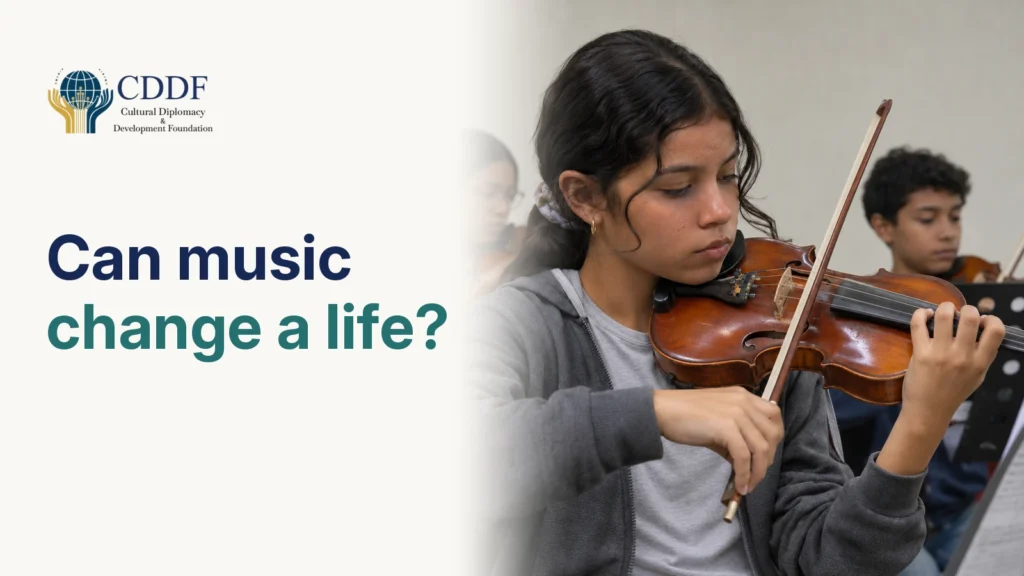
Few youth music programs carry as much hope as El Sistema, the Venezuelan network of children’s orchestras that began in 1975 and inspired hundreds of copies abroad. Its promise is simple to state: put an instrument in the hands of a child from a poor neighborhood, give that child several hours of ensemble playing a week, and the effects will reach well beyond music, into behavior, schooling and a sense of the future.
That promise has attracted government budgets, development bank loans and philanthropic money on three continents. It has also attracted scrutiny. A randomized trial in Venezuela, a decade of evaluation in Scotland, brain-imaging studies in Los Angeles and a sharp academic critique now give a fuller picture than the concert footage ever did.
This article sets out what those studies found, where they disagree, and what a foundation, city or school district can learn before funding a youth orchestra of its own. The short answer is that the evidence supports modest, real benefits for some children, and that how a program is run matters at least as much as the fact that it uses music.
How El Sistema began and grew
José Antonio Abreu, an economist and musician, started the program in 1975 in a garage with nine young musicians, according to NBC News. By the time of his death in March 2018, aged 78, it had grown to more than 300 teaching locations and reached hundreds of thousands of children, as NPR reported. Sistema Global, a nonprofit that links programs worldwide, puts the Venezuelan figure at 400,000 children (Sistema Global). Official counts vary from year to year, so these figures are best read as orders of magnitude.
The local teaching center is called a núcleo. Children join young, play in ensembles from the start, and spend many hours a week together after school. The model’s best-known graduate is the conductor Gustavo Dudamel, who began as a violinist in one of Abreu’s youth orchestras, led the Simón Bolívar Youth Orchestra from the age of 17, and went on to become music director of the Los Angeles Philharmonic (NPR).
Money came largely from the state. NPR describes El Sistema as separate from the government but dependent on public funding. The Inter-American Development Bank (IDB) added loans: an earlier USD 8 million loan to improve quality and expand coverage, described in an undated IDB article that counted 60 centers and about 57,000 children (IDB), and a USD 150 million loan for a second phase, approved on June 6, 2007 (IDB project VE-L1017). The program has not been insulated from Venezuela’s political turmoil; in 2017 officials canceled a planned tour by Dudamel and the national youth orchestra after he publicly criticized the government (NPR). We mention this only because state dependence is part of the model’s design, and it carries risks for any program that copies it.
A timeline of the movement and its evidence
| Year | Event |
|---|---|
| 1975 | Abreu founds El Sistema in Venezuela with a handful of young musicians. |
| 1996 to 1997 | First evaluations prepared in connection with IDB lending, later criticized by Baker, Bull and Taylor for adopting the program’s own narrative. |
| 2007 | IDB approves a USD 150 million loan (June 6). Youth Orchestra Los Angeles (YOLA) is founded. |
| 2011 | IDB and Fundamusical, which runs El Sistema, agree to design a rigorous impact evaluation. |
| 2012 to 2013 | Randomized trial fieldwork in 16 núcleos across five Venezuelan states. |
| 2013 | Glasgow Centre for Population Health (GCPH) begins evaluating Big Noise in Scotland. |
| 2014 | Oxford University Press publishes Geoffrey Baker’s critical study of El Sistema. |
| 2016 to 2017 | Trial results published in Prevention Science; USC brain studies of YOLA children published. |
| 2018 | Abreu dies. Baker, Bull and Taylor publish a critique of El Sistema evaluations. |
| 2025 | El Sistema USA census reports 142 member programs for 2024. |
| 2026 | GCPH publishes Trust the process, a long-term assessment of Big Noise. |
What the randomized trial in Venezuela found
Before 2012, the program had never been tested with a design that could separate its effects from the kind of families who choose to enroll. Demand exceeded places, so researchers ran a lottery. Families of 2,914 children aged 6 to 14 at 16 núcleos were offered admission either in September 2012 or a guaranteed place a year later. The results appeared in Prevention Science (Alemán, Duryea, Guerra, McEwan, Muñoz, Stampini and Williamson, published online in November 2016, volume 18, 2017).
After one year the findings were these:
- Child-reported self-control rose by 0.10 standard deviations and behavioral difficulties fell by 0.08 standard deviations, both significant only at the 10 percent level after correction for multiple tests.
- Guardians did not report significant changes in the same traits.
- There were no full-sample effects on memory, visual-spatial reasoning or school functioning.
- Effects were larger for children whose mothers had no college education and for boys, especially boys exposed to violence, whose aggressive behavior fell by 0.24 standard deviations.
- Some subgroups moved in the wrong direction, including lower measured empathy among girls exposed to violence.
Participation was lower than a reader of program brochures might expect. In the first semester, 69 percent of children offered a place attended, against 15 percent of the comparison group, and only 56 percent of the early group attended in both semesters. Because the estimates compare children by the offer they received rather than by actual attendance, the effect on children who stayed is likely larger, but the study cannot say by how much.
The authors list their own limits: outcomes came from child and guardian reports rather than teachers or tests of behavior, follow-up lasted one year, and oversubscribed núcleos may have been better than average. An IDB blog post by the same team described the study as the first experimental evaluation of a scaled-up, government-run music program in any country, and presented the self-control gain as a 1.13 percent increase. Both framings describe the same small effect.
Evidence from Sistema-inspired programs
Outside Venezuela, programs adapted the model to local schools and budgets. Three are well documented.
Big Noise in Scotland
Sistema Scotland runs Big Noise centers in six communities, among them Raploch in Stirling and Govanhill in Glasgow (Big Noise). The GCPH began evaluating it in 2013. Its 2015 initial findings drew on interviews with about 250 people, program data and a week-long Education Scotland inspection at Raploch, and covered about 1,300 participants. It reported higher school attendance among participants than among non-participants, without publishing the figures. A Glasgow Caledonian University cost-benefit model for Govanhill projected a positive net present value at every horizon tested, rising to about £89 million over 70 years. The report says plainly that the long-term pathways were theorized, not measured.
In June 2026 the GCPH published Trust the process, which used participatory systems mapping with staff and young people. It reports gains in musical skill, confidence, relationships, wellbeing and ambitions, and names the features that seemed to matter: consistent delivery principles, trusted relationships, safe and creative spaces, and a collaborative orchestral model.
YOLA in Los Angeles
The Los Angeles Philharmonic founded YOLA in 2007, and by 2016 it served more than 750 students at three sites (LA Phil press release). A University of Southern California team followed about 20 children who joined YOLA at age 6 or 7, alongside 19 children in a sports program and 21 in no specific program. Two 2017 papers reported differences in brain structure and in a network linked to decision-making (USC News). The groups were small and not randomly assigned, so the results show association rather than cause.
The US network
El Sistema USA counted 142 member programs in 2024. Its 2024 census, based on 84 responses, estimated 31,787 students, an average of about seven hours of instruction a week, and an average investment of USD 2,401 per student. Some 71 percent of programs charge no tuition. The census also found that 45 percent of teaching staff had been with their program only one to two years.
Comparing the main evaluations
| Program and place | Method | Main finding |
|---|---|---|
| El Sistema, 16 núcleos in Venezuela | Randomized offer of admission, 2,914 children, one year | Self-control up 0.10 SD and difficulties down 0.08 SD; no cognitive gains; larger effects for vulnerable boys |
| El Sistema, Venezuela (Cuesta, 2011) | Cost-benefit study used in IDB lending | Reported a 1:1.68 ratio; Baker, Bull and Taylor say it showed correlation, not causation |
| Big Noise, Raploch and Govanhill | Interviews, program data, inspection, cost-benefit model | Positive short-term impacts; long-term pathways theorized, not measured |
| Big Noise, six centers | Participatory systems mapping and economic assessment (2026) | Gains in skills, confidence, wellbeing and relationships; full impact still developing |
| YOLA at HOLA, Los Angeles | Small non-randomized comparison with MRI and EEG | Brain differences associated with music training |
The critics’ case
The most sustained criticism comes from the musicologist Geoffrey Baker. His book El Sistema: Orchestrating Venezuela’s Youth (Oxford University Press, 2014) drew on more than a year of fieldwork in Venezuela. As summarized by the Eastman School of Music’s Institute for Music Leadership, Baker argued that the program’s discipline and hierarchy sit uneasily with its social claims, that it serves fewer very poor children than advertised, and that insiders described favoritism and a climate in which critics feared reprisal. Most of his interviewees were anonymous.
Supporters pushed back. Eric Booth, a leading US advocate, faulted the book for relying on few named sources and no statistical data, and disputed the claim about poverty (Eastman). In the New York Review of Books, Nicholas Kenyon wrote that Baker found no concrete evidence for his gravest accusations and should have interviewed Abreu. Baker replied that anonymity is standard practice and that advocates had relied on reportage rather than peer-reviewed research.
Baker later turned to the evaluations themselves. In a 2018 paper in the British Journal of Music Education, Baker, Bull and Taylor argued that many evaluations work as advocacy. They noted that the Venezuelan trial was registered after data collection, used a 10 percent significance threshold, and found significant results on 2 of 26 outcomes, and that three of its authors worked for the IDB, a long-term funder. They also criticized a New Zealand evaluation that, by their account, omitted a 47 percent dropout rate.
Reading the evidence together
Our reading is that the two camps are less far apart than the tone of the debate suggests. The trial’s own authors call their effects modest and short-term. Baker’s critique is strongest on governance and on how evidence was communicated, and weakest where it relies on testimony that cannot be checked. Neither side has shown that orchestral training reliably lifts school performance.
What does seem consistent is a pattern of benefit concentrated among children with the most to gain, together with the finding from Scotland that relationships and stability carry much of the effect. If that is right, the orchestra is the vehicle and the adults around it are much of the engine. That has practical consequences for anyone designing a program, and it links to the wider case for culture in development set out in Culture is development, not decoration.
What youth music programs cannot do
The limits are worth stating plainly, because funders often hear only the promise.
- They are not a proven route to higher test scores. The Venezuelan trial found no full-sample cognitive gains after a year.
- They cannot reach children who leave. Roughly half of those offered a place in Venezuela attended for a full year.
- Positive effects for one group can sit beside negative effects for another, as the results for some girls showed.
- Most evaluations are commissioned by the programs or their funders, and few follow children for more than a few years.
- A program dependent on a single public funder can be exposed to political change, as Venezuela’s experience suggests.
- Cost-benefit projections such as the 70-year Scottish model rest on assumptions about long-term pathways that have not yet been observed.
None of this means the money is wasted. It means a program should be judged on what it can show, not on what the model is said to achieve.
Designing youth music programs that deliver
For a foundation, city or school district, the evidence points to a set of design choices that can be made from the start.
Set goals you can measure
Decide whether the aim is musical skill, wellbeing, school engagement or something else, and pick two or three outcomes. A program that promises to change everything cannot be shown to have changed anything.
Measure honestly and early
- Collect baseline data before children start, including attendance and simple wellbeing measures.
- Where places are oversubscribed, consider a fair lottery, as the Venezuelan team did, and register the analysis plan before collecting outcome data.
- Use more than one reporter: children, parents and teachers often see different things.
- Track dropout and publish it alongside the gains.
- Commission at least part of the evaluation from researchers who are independent of the program and its funders.
Reach the children who need it most
The strongest effects in Venezuela appeared among boys exposed to violence and children of less-educated mothers. Recruitment that relies on families signing up will tend to miss them. Working through schools, as Big Noise does at Raploch where all children on the campus receive musicianship lessons, is one way to widen the door. Transport and meals matter too: about a third of US programs offer them (El Sistema USA).
Put pedagogy and wellbeing first
Baker’s critique and the Scottish findings point the same way: the quality of relationships and the culture of rehearsal shape what children take away. Train teachers in child development as well as music, set clear safeguarding rules, and give children ways to raise concerns. Staff stability deserves a budget line, given how many US teaching staff are new to their programs.
Fund for the long term
Big Noise has evaluated its work since 2013, and the GCPH still describes its full impact as developing. Funders should plan for commitments of five years or more and spread risk across public and private sources.
Let young people shape the program
Young people in the Big Noise afterschool program reviewed and amended the maps of how the program affects them. Repertoire, leadership roles and feedback can be opened up in the same way. The case for young people’s participation in cultural life is made in more detail in Who gets a seat at the table?.
Where music meets cultural exchange
Youth orchestras also travel. Tours, joint ensembles and teacher exchanges link programs across borders, and Sistema Global’s directory lists more than 245 programs in over 50 countries (Sistema Global). The diplomatic uses of orchestras are discussed in What an orchestra and a desert road teach us about peace, and the wider evidence on exchange in Why people-to-people exchange still works. The same caution applies: an exchange visit is a good experience, and it becomes evidence only when someone measures what changed.
Key terms
El Sistema: Venezuela’s national network of youth orchestras and choirs, founded by José Antonio Abreu in 1975.
Núcleo: A local El Sistema teaching center where children receive instruction and play in ensembles after school.
Randomized controlled trial: A study that assigns participants by lottery so that differences in outcomes can be attributed to the program.
Intention-to-treat: An analysis that compares groups by the offer they received, whether or not each child actually attended.
Standard deviation (SD): A measure of spread used to express effect sizes; 0.10 SD is generally considered a small effect.
Questions for discussion
- If a program’s effects are concentrated among the most vulnerable children, how should it decide whom to recruit?
- Should evaluations funded by a program’s lenders or sponsors carry the same weight as independent research?
- How can a youth orchestra keep the discipline that ensemble playing needs without becoming authoritarian?
- What would convince you that a youth music program had changed a child’s life, rather than his or her week?
Frequently asked questions
Does El Sistema improve children’s school results?
The randomized trial in Venezuela found no full-sample effects on cognitive skills or guardian-reported school functioning after one year.
What did the El Sistema trial find?
One year of access raised child-reported self-control by 0.10 standard deviations and lowered behavioral difficulties by 0.08, with larger effects for boys exposed to violence.
Who is Geoffrey Baker?
He is a musicologist whose 2014 book El Sistema: Orchestrating Venezuela’s Youth questioned the program’s social claims and governance.
How many El Sistema-inspired programs are there?
Sistema Global lists more than 245 programs in over 50 countries, and El Sistema USA had 142 member programs in 2024.
Is Big Noise the same as El Sistema?
No. Big Noise is run by Sistema Scotland, an independent organization inspired by the Venezuelan model and adapted to Scottish schools and communities.
What makes a youth music program effective?
Evaluations point to consistent delivery, trusted relationships with staff, safe spaces, long-term funding and honest measurement of who attends and who leaves.
Closing thoughts on youth music programs
Can an orchestra change a child’s life? For some children, the evidence suggests it can change something measurable, mostly self-control and behavior, and mostly among those with the hardest starts. It has not been shown to transform school results, and the gains depend on who stays, who teaches and how long the money lasts.
That is enough to justify youth music programs, provided they are designed and judged as social programs as well as artistic ones. A funder weighing a new orchestra could start with one test: ask for the dropout rate alongside the success stories. Readers working on related questions can find more of our material on the research and interviews page.
Key takeaways
- El Sistema’s randomized trial found small gains in self-control and behavior after one year and no full-sample cognitive gains.
- The largest benefits appeared among boys exposed to violence and children of mothers without college education.
- Geoffrey Baker’s critique focuses on governance, culture and the independence of evaluations, and has been disputed by supporters.
- Scottish evaluations of Big Noise point to relationships, consistency and safe spaces as the features that matter most.
- Programs should set measurable goals, track dropout, commission independent evaluation and plan funding over five years or more.
Sources
- NBC News, José Abreu, creator of Venezuelan El Sistema youth orchestras, dies (March 2018).
- NPR, José Abreu, Venezuelan conductor who envisioned musical education for all, dead at 78 (March 26, 2018).
- Sistema Global, About (accessed 2026).
- Inter-American Development Bank, Music with social overtones (undated).
- Inter-American Development Bank, Support to the Action Social Center of Music Program, Phase II (VE-L1017) (approved June 6, 2007).
- Alemán, Duryea, Guerra, McEwan, Muñoz, Stampini and Williamson, The effects of musical training on child development: a randomized trial of El Sistema in Venezuela, Prevention Science 18 (2017).
- Inter-American Development Bank, Music as an opportunity for development (October 19, 2017).
- Big Noise, Sistema Scotland home page (accessed 2026).
- Glasgow Centre for Population Health, Evaluating Sistema Scotland: initial findings report, summary (May 2015).
- Glasgow Centre for Population Health, Trust the process: Big Noise impact on participants, families and their wider communities (June 2026).
- Los Angeles Philharmonic, YOLA press release (June 14, 2016).
- USC News, Music training can change children’s brain structure and boost decision-making network (November 13, 2017).
- El Sistema USA, ESUSA Census Report 2024 (September 2025).
- Institute for Music Leadership, Eastman School of Music, An El Sistema controversy (March 20, 2015).
- New York Review of Books, El Sistema’s enemy (November 19, 2015).
- Baker, Bull and Taylor, Who watches the watchmen? Evaluating evaluations of El Sistema, British Journal of Music Education 35(3) (2018).