At a glance
- UNESCO placed Kyrgyz ala-kiyiz and shyrdak felt carpets on its Urgent Safeguarding List in 2012, noting that most practitioners are over forty.
- The Margilan Crafts Development Centre, founded by the local community in 2007, was selected for UNESCO’s Register of Good Safeguarding Practices in 2017.
- The World Fair Trade Organization asks buyers of handicrafts to make an interest-free prepayment of at least 50% when producers request it.
In this article
Ask what links crafts and development in Central Asia and the usual answer is a market stall: a felt slipper, a silk scarf, a tourist paying in cash. The more useful answer is about who makes the object, how much of the price reaches her, and whether her daughter will want to learn the work. In much of rural Kyrgyzstan, Uzbekistan and Tajikistan, the maker is a woman, often working at home, often in a household where men have left to find work abroad.
This article looks at three cases from the region: Kyrgyz felt carpets, the ikat silk of Margilan in Uzbekistan’s Fergana Valley, and small women’s craft groups in Tajikistan. Each shows a different part of the problem. Felt shows what happens when a craft loses its domestic use. Margilan shows what a well organized revival can do and where it can go wrong. The Tajik groups show how modest income from handwork changes daily life in households shaped by labor migration.
Our argument is simple, and it is ours rather than any single source’s. Craft becomes development when it pays a fair and regular income, keeps skills moving between generations, and leaves makers in control of their designs. When it does none of these things, it is a souvenir trade with a heritage label on it.
Why craft is an economic question
Handwork is a large employer, though it is hard to measure. When the Alliance for Artisan Enterprise launched at the U.S. State Department in November 2012, the Aspen Institute described artisan activity as the second largest employer in the developing world after agriculture, with participants who are “largely women” (Aspen Institute). The nonprofit Nest puts the value handworkers add to global GDP at over $718 billion and says upwards of 300 million people work from home, mostly in craft-based handwork (Nest). Nest gives no method or year for these figures, so we read them as an order of magnitude.
In Central Asia, the pressure comes from the rural labor market. A 2018 article from the Food and Agriculture Organization (FAO) stated plainly that “agriculture itself cannot provide decent jobs to fast-growing rural populations,” and noted that many people migrate to Russia or Kazakhstan for work (FAO). Women who stay behind in villages often need income that fits around farm work and child care. Craft fits that pattern because it uses local materials such as wool and reeds and can be done at home or in a nearby workshop.
That is the opportunity. The risk is that home-based work is also easy to underpay, hard to count, and invisible to most labor protections. The earlier article on culture as development set out the macro case; this one stays close to the workshop.
Felt in the Kyrgyz mountains
Kyrgyz felt carpets come in two main types, ala-kiyiz and shyrdak. In 2012 UNESCO inscribed them on the List of Intangible Cultural Heritage in Need of Urgent Safeguarding (UNESCO). The nomination file ties the carpets to nomadic life, where they warmed and decorated the home, and describes the knowledge as passing mainly from older women to younger women within families, in rural and mountainous areas.
The reasons for the urgent listing are specific. UNESCO’s entry lists the following threats:
- Most practitioners are over forty, and younger people show little interest in learning.
- Cheap synthetic carpets dominate the market.
- Raw materials are scarce and often of poor quality.
- There was a lack of government safeguarding at the time of nomination.
The entry also says that ala-kiyiz carpets “have practically disappeared from Kyrgyz homes” and that shyrdaks are under serious threat. That detail matters. A craft that families no longer use for themselves depends entirely on outside buyers, and outside buyers want different sizes, colors and price points than a household does.
Organized support for felt makers began well before the listing. The Central Asian Crafts Support Association (CACSA), a non-governmental organization founded in 2000, works with craftspeople in more than 76 member organizations across the five Central Asian republics, according to the International Quilt Museum’s World Quilts: The Central Asian Story. The same source describes Art Group Tumar in Bishkek as a felt producer with 150 employees, ninety percent of them women, working through nineteen private workshops and exporting to North America and Europe. These figures describe the company at the time of publication and may have changed.
Silk in Margilan
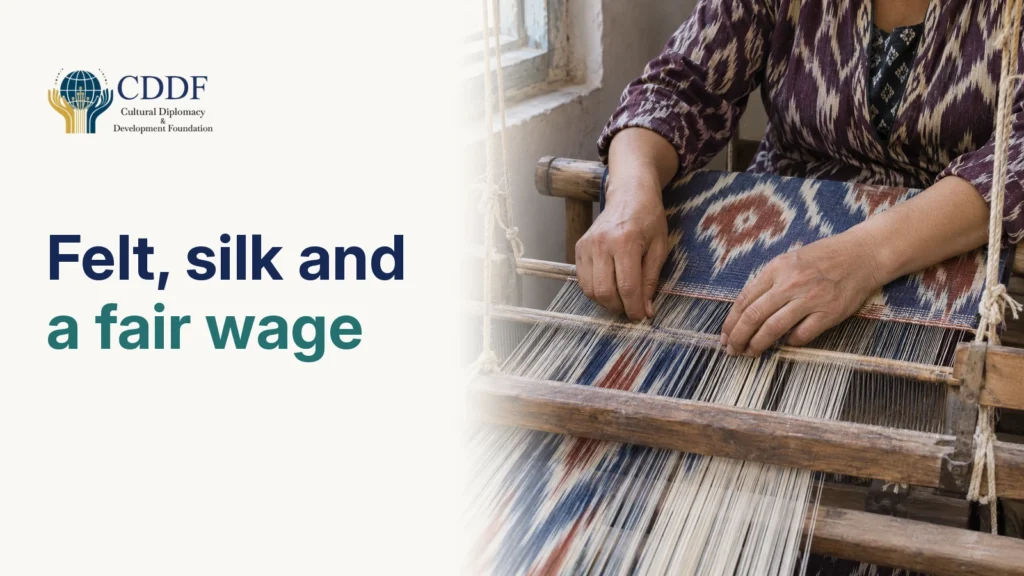
Margilan is the historic center of ikat weaving in what is now Uzbekistan, and UNESCO dates atlas and adras making in the territory to the Late Antique period. Soviet-era production put some handmade techniques at risk. In 2007 the local community set up the Crafts Development Centre to safeguard and promote atlas and adras making through training, exhibitions, craft fairs, festivals and published manuals. In 2017 UNESCO selected the centre for its Register of Good Safeguarding Practices (UNESCO).
The committee decision is worth reading in full (UNESCO decision 12.COM 11.E.4). It credits the centre with transmission to young people, sustainable income generation and public-private partnership, and it sees a possible model for social enterprise. It also raises a concern about hierarchical working relationships among stakeholders inside the centre, and asks Uzbekistan to make sure working conditions follow UNESCO’s ethical principles. A good safeguarding practice, in other words, can still have problems with who decides and who earns.
Uzbekistan’s official tourism portal gives a sense of scale (Uzbekistan.travel). It reports that more than 1,000 Margilan families work in handicrafts and more than 500 local artisans belong to the Hunarmand national artisans’ association. It describes the Yodgorlik silk factory, opened in 1972, as producing entirely by hand, and a newer craft center built in 2020 through a public-private partnership as employing 600 craftspeople and exporting to Turkey, the United States, Italy, France and other countries. These are the portal’s own descriptions and have not been independently audited.
Women’s craft groups in Tajikistan
The Tajik examples are smaller and closer to household economics. In November 2010, six women in the village of Shahraki Somoniyon in Sughd province formed a handicraft group called Umed, meaning hope. They knit scarves and socks, sew traditional kurpa bed covers and embroider headscarves, and sell at the local market. The group used an interest-free state loan to buy raw materials, with support from the Central Asia Regional Migration Programme run in Tajikistan by UN Women with the International Organization for Migration and the World Bank. UN Women reported that the program had assisted 1,966 families in the province through self-help groups (UN Women).
Farther east, in the mountain villages of Gorno-Badakhshan, the Central Asia Institute’s ASPIRE program has trained more than 350 women since 2019 in skills such as embroidery, knitting, baking and reed basket weaving (Central Asia Institute). One embroiderer told the reporter, “Before, I did not know how to sell my products,” and credited the training with teaching her to price and find clients. A basket weaver in the same report had taught 15 other women in her village. Several participants explained the work in terms of migration: their husbands were abroad, and the household needed another income.
Neither source gives income figures. What they do show is the kind of support that seems to matter most at this scale: small capital for materials, pricing and sales skills, and a group that shares risk. Gender is central here, and readers interested in that side of the question can also see our piece on women and youth in cultural diplomacy.
The cases side by side
The table sets the main crafts and programs side by side, with the main pressure or support each source documents.
| Craft or program | Country | Materials | What threatens or supports it |
|---|---|---|---|
| Ala-kiyiz and shyrdak felt carpets | Kyrgyzstan | Felted wool | Threat: aging makers, synthetic carpets, scarce raw materials (UNESCO, 2012) |
| Art Group Tumar felt | Kyrgyzstan | Felted wool | Support: export markets, 150 staff, mostly women |
| Atlas and adras ikat | Uzbekistan | Silk, natural dyes | Support: Crafts Development Centre, UNESCO register (2017) |
| Wool, weaving and dyeing workshops | Kyrgyzstan, Uzbekistan | Wool, plants, reeds | Support: FAO and CACSA training of more than 90 people (2018) |
| Umed knitting and sewing group | Tajikistan | Yarn, fabric | Support: interest-free loan, self-help group model |
| ASPIRE embroidery and baskets | Tajikistan | Thread, reeds | Support: training in pricing and sales, 350+ women |
What fair income requires
The clearest public standard for fair pay in craft comes from the World Fair Trade Organization (WFTO). Its fourth principle defines fair payment as one “mutually negotiated and agreed by all through on-going dialogue and participation,” aiming at a local living wage for a standard working week of no more than 48 hours, with equal pay for equal work by women and men (WFTO). Its third principle asks buyers of handicraft products to make an interest-free prepayment of at least 50% on request, and requires suppliers who receive a prepayment to pass it on to the producers.
The prepayment rule addresses one of the oldest traps in craft. A felt maker or weaver needs to buy wool, silk or dye weeks before she is paid for the finished piece. Without capital, she either borrows at high cost or sells to a middleman who supplies materials and sets the price. The Umed group’s interest-free loan solved the same problem through the state rather than through a buyer.
Fair payment is harder to apply to home-based work than to a workshop, because hours are irregular and the line between paid work and housework blurs. In our reading, the most practical test is whether the maker knows the final retail price and agreed to her share of it.
Limits and risks
The evidence for crafts as a route out of rural poverty in Central Asia is thinner than the enthusiasm around it. Most published material comes from the organizations running programs, and most reports count people trained rather than income earned a year later. The sources used here are no exception.
Several risks recur:
- Low incomes. Craft income is often seasonal and small, and none of the Tajik program reports cited here gives an earnings figure.
- Middlemen. When makers cannot reach buyers directly, traders capture much of the margin and decide what gets made.
- Imitation. UNESCO names cheap synthetic carpets as a direct threat to Kyrgyz felt, and WIPO notes that the design, reputation and style of handicrafts are “vulnerable to imitation and misappropriation” (WIPO).
- Hierarchy. The UNESCO committee’s concern about working relationships in Margilan shows that a successful center can still concentrate decisions and earnings at the top.
- Freezing the tradition. Products made for tourists can settle into a fixed set of colors and motifs that buyers expect, which may help sales in the short run and narrow the craft over time.
UNESCO’s own Ethical Principles for Safeguarding Intangible Cultural Heritage, endorsed in 2015, speak to that last point. Principle 8 says the “dynamic and living nature” of heritage should be respected, and that safeguarding should not be held back by demands for fixed authenticity. Principle 7 says communities should benefit from the moral and material interests that arise from their heritage. A craft economy that pays poorly for a frozen product fails both tests.
Putting the lessons to work
For a foundation, municipality or development agency that wants to support crafts and development in a region like this, the cases suggest five areas of work. They are listed roughly in the order a new program meets them.
Design and market access
Makers need to know what distant buyers want without giving up their own patterns. Short design residencies, trade fair places and help with online sales are more useful than one-off exhibitions. The FAO workshops in Kyrgyzstan and Uzbekistan used a train-the-trainer approach so that skills spread after the visiting masters left.
Fair pricing
Teach costing before selling. The ASPIRE embroiderer’s remark about not knowing how to sell is typical. A program can publish a simple cost sheet (materials, hours, a local wage rate, overhead) and use the WFTO principles as the benchmark for agreements with buyers, including prepayment.
Documentation and apprenticeship
Record patterns, dye recipes and the names of master makers, with their consent, and pay masters to teach. The Kyrgyz felt listing shows what happens when transmission depends only on families and young people drift away.
Protecting designs from copying
WIPO lists collective and certification trademarks, geographical indications, copyright and unfair competition law as tools available to artisans. A cooperative can register a collective mark for its felt or silk far more cheaply than each maker could act alone.
Tourism links
Workshop visits, festivals and sales to visitors bring cash, as Margilan’s open workshops and annual silk festival show. Tourism works best when visitors buy directly from makers and see the work in progress, and less well when it turns a living craft into a stage set. Our article on heritage tourism in Silk Road cities looks at this in more detail.
A program that wants a practical sequence could follow these steps:
- Map who makes what, where, and at what price, using makers’ own figures.
- Fund materials through prepayment or interest-free loans before asking for new designs.
- Train in costing, pricing and direct sales alongside technique.
- Pay master makers to teach apprentices, and record their knowledge with consent.
- Register a collective mark or certification scheme for the group’s products.
- Measure income a year after training, alongside the number of people trained.
A short timeline
The dates below come from the sources cited in this article.
| Year | Event | Source |
|---|---|---|
| 1972 | Yodgorlik silk factory opens in Margilan | Uzbekistan.travel |
| 2000 | Central Asian Crafts Support Association founded | International Quilt Museum |
| 2007 | Margilan Crafts Development Centre founded by the local community | UNESCO |
| 2010 | Umed handicraft group formed in Sughd province, Tajikistan | UN Women |
| 2012 | Kyrgyz felt carpets inscribed for urgent safeguarding | UNESCO |
| 2012 | Alliance for Artisan Enterprise launched in Washington | Aspen Institute |
| 2015 | UNESCO Ethical Principles for intangible heritage endorsed | UNESCO |
| 2017 | Margilan centre selected for the Register of Good Safeguarding Practices | UNESCO |
| 2018 | FAO-supported craft workshops in Kyrgyzstan and Uzbekistan | FAO |
| 2019 | ASPIRE women’s program begins in Tajikistan | Central Asia Institute |
What we take from the cases
Read together, the three cases point to a few conclusions, which are our own. Heritage listing helps attention and funding but does not by itself raise incomes; the Kyrgyz felt listing named the threats clearly, and the cure for synthetic competition is a market that pays for the real thing. Organized centers can revive a technique, as Margilan did, but they need the same scrutiny of pay and decision making as any employer. And at the village scale, the biggest gains seem to come from basic business support: capital for materials, pricing skills and a group to sell through.
None of this requires a craft to stay as it was. Felt makers who adapt sizes and colors for export, or silk weavers who supply fashion houses, are still practicing their craft. The question for funders is whether the maker sets the terms.
Key terms
Ala-kiyiz: A Kyrgyz felt carpet type listed by UNESCO in 2012, now rarely found in Kyrgyz homes.
Shyrdak: The second main type of Kyrgyz felt carpet, also covered by the 2012 UNESCO urgent safeguarding listing.
Atlas and adras: Traditional patterned fabrics of Margilan whose making UNESCO recognized as a good safeguarding practice in 2017.
Local living wage: In the WFTO standard, pay for a working week of no more than 48 hours that covers a decent standard of living.
Collective mark: A trademark owned by an association that its members may use to show goods come from the group.
Questions for discussion
- If a craft no longer has a use in local homes, should support focus on export markets or on restoring local demand?
- How could a program verify that makers receive a fair share of the retail price when they work from home?
- What would a fair working relationship look like inside a large craft center such as Margilan’s?
- When does adapting a craft for new buyers keep it alive, and when does it empty it out?
Frequently asked questions
Why are Kyrgyz felt carpets on UNESCO’s urgent list?
UNESCO listed them in 2012 because most makers are over forty, young people show little interest, and cheap synthetic carpets and poor raw materials undercut the craft.
What is the Margilan Crafts Development Centre?
It is a community initiative founded in 2007 to revive atlas and adras ikat making in Uzbekistan, and UNESCO selected it as a good safeguarding practice in 2017.
Does craft work actually raise women’s incomes in Central Asia?
Program reports show women starting businesses and selling their work, but they rarely publish income figures, so the size of the gain is not well measured.
What does fair trade mean for a craft producer?
Under WFTO principles it means a negotiated price that aims at a local living wage, equal pay for women and men, and an interest-free prepayment of at least 50% on request.
How can artisans protect their designs from copies?
WIPO points to collective and certification marks, geographical indications, copyright and unfair competition law, which a cooperative can use on behalf of its members.
Is tourism good for traditional crafts?
It brings direct sales when visitors buy from makers, but it can also lock a craft into a fixed souvenir style if tourist demand sets the designs.
Closing thoughts on crafts and development
The link between crafts and development in Central Asia is real but conditional. Kyrgyz felt, Margilan silk and the women’s groups of Sughd and Gorno-Badakhshan show the same pattern: skills survive where making them pays, and pay improves where makers have capital, pricing knowledge and a direct route to buyers. Heritage status helps, though it does not replace those basics.
For funders, the most useful single change may be in what they measure. Counting trainees is easy; counting what a maker earns from her work a year later is harder and says much more. Readers can follow related work on our research and interviews page, and the next step for any program is a baseline of makers’ prices and incomes before the first workshop begins.
Key takeaways
- Kyrgyz felt carpets were listed for urgent safeguarding in 2012 because makers are aging and synthetic carpets dominate the market.
- The Margilan centre is a recognized model, but UNESCO also flagged hierarchical working relationships inside it.
- Small Tajik women’s groups gained most from interest-free capital, pricing skills and group selling.
- WFTO principles give a usable benchmark: a living wage, equal pay and at least 50% prepayment on request for handicrafts.
- Programs should measure what makers earn over time as well as how many were trained.
Sources
- UNESCO, Ala-kiyiz and Shyrdak, art of Kyrgyz traditional felt carpets (inscribed 2012).
- UNESCO, Margilan Crafts Development Centre, safeguarding of the atlas and adras making traditional technologies (selected 2017).
- UNESCO, Decision of the Intergovernmental Committee: 12.COM 11.E.4 (2017).
- UNESCO, Ethical Principles for Safeguarding Intangible Cultural Heritage (2015).
- Uzbekistan.travel, Margilan craft centers.
- International Quilt Museum, World Quilts: The Central Asian Story, Carrying on the Tradition (2017).
- FAO Regional Office for Europe and Central Asia, Craft skills from Hungary could open new opportunities in rural Central Asia (12 February 2018).
- UN Women Europe and Central Asia, In Tajikistan, rural women gain business skills and independence through self-help groups (11 April 2013).
- Central Asia Institute, The Women Reviving the Folk Crafts of Tajikistan (1 March 2024).
- Aspen Institute, U.S. Secretary of State Hillary Clinton Announces the Launch of Alliance for Artisan Enterprise (30 November 2012).
- Nest, Why Craft.
- World Fair Trade Organization, Our 10 Fair Trade Principles.
- WIPO, IP and Traditional Handicrafts.